QENTAK RESEARCH · 2026 EDITION
Alberta: independent and home education, 2026 Edition
Alberta reports more home-educated children than any other province, and the highest home-education rate among the provinces. It also shows why definitions matter: two respected sources put its independent share at 4.9% and 6.7%.
Snapshot
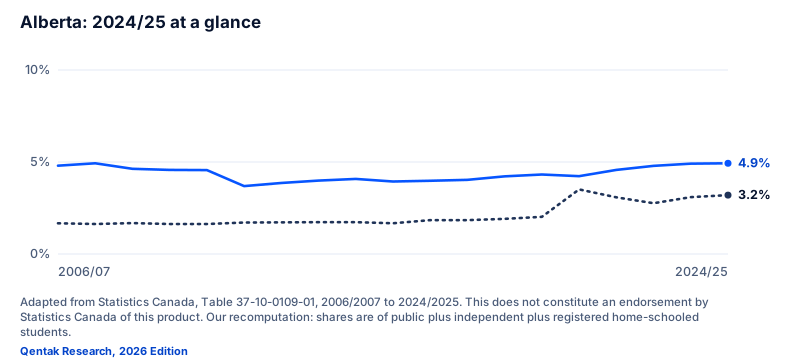
Alberta: 2024/25 at a glance
39,969 independent students (4.9%); 25,977 registered home-educated (3.2%); funds independent schools at ≈70% of a public amount.
| School year | Independent | Independent share | Home-educated | Home-education share |
|---|---|---|---|---|
| 2006/07 | 28,767 | 4.80% | 9,984 | 1.67% |
| 2007/08 | 29,520 | 4.93% | 9,747 | 1.63% |
| 2008/09 | 27,864 | 4.63% | 10,113 | 1.68% |
| 2009/10 | 27,690 | 4.57% | 9,855 | 1.63% |
| 2010/11 | 27,828 | 4.56% | 9,969 | 1.63% |
| 2011/12 | 22,425 | 3.69% | 10,386 | 1.71% |
| 2012/13 | 24,159 | 3.86% | 10,785 | 1.72% |
| 2013/14 | 25,707 | 3.99% | 11,136 | 1.73% |
| 2014/15 | 27,129 | 4.08% | 11,487 | 1.73% |
| 2015/16 | 26,775 | 3.94% | 11,322 | 1.67% |
| 2016/17 | 27,537 | 3.98% | 12,732 | 1.84% |
| 2017/18 | 28,488 | 4.03% | 13,023 | 1.84% |
| 2018/19 | 30,270 | 4.22% | 13,689 | 1.91% |
| 2019/20 | 31,500 | 4.32% | 14,730 | 2.02% |
| 2020/21 | 30,465 | 4.23% | 25,305 | 3.51% |
| 2021/22 | 33,447 | 4.57% | 22,539 | 3.08% |
| 2022/23 | 36,201 | 4.79% | 20,868 | 2.76% |
| 2023/24 | 38,592 | 4.91% | 24,279 | 3.09% |
| 2024/25 | 39,969 | 4.93% | 25,977 | 3.20% |
- Independent share
- Registered home-education share
- Independent change since 2006/07+39%
- Fraser share, 2023/246.7%
- Outside public, 2024/258.1%
Adapted from Statistics Canada, Table 37-10-0109-01, 2006/2007 to 2024/2025. This does not constitute an endorsement by Statistics Canada of this product. Our recomputation: shares are of public plus independent plus registered home-schooled students.
Cite this chart
Adapted from Statistics Canada, Table 37-10-0109-01, 2006/2007 to 2024/2025. This does not constitute an endorsement by Statistics Canada of this product. Our recomputation: shares are of public plus independent plus registered home-schooled students. Chart: "Alberta: 2024/25 at a glance", Qentak Research, The State of Independent & Home Education in Canada, 2026 Edition. https://qentak.com/research/canada/alberta#chart-province-alberta-snapshot
Embed as an image
<figure>
  <img src="https://qentak.com/research/charts/province-alberta-snapshot.svg" alt="Line chart of Alberta's independent share (solid) and registered home-education share (dotted) of K-12 students, 2006/07 to 2024/25." width="800" style="max-width:100%;height:auto">
  <figcaption>Adapted from Statistics Canada, Table 37-10-0109-01, 2006/2007 to 2024/2025. This does not constitute an endorsement by Statistics Canada of this product. Our recomputation: shares are of public plus independent plus registered home-schooled students. Chart by <a href="https://qentak.com/research/canada/alberta#chart-province-alberta-snapshot">Qentak Research</a>.</figcaption>
</figure>
Qentak's own text and charts are free to share with attribution. Statistics Canada data is used under the Open Licence; the full chapter on data, sources and terms is on the data page.
At a glance
| Measure | Figure | Source and year |
|---|---|---|
| Registered home-educated | 25,977 (3.2%) in 2024/25; 14,730 in 2019/20; 25,305 in 2020/21 | Statistics Canada |
| Home education, Alberta Education | 24,158 home education plus 2,274 shared responsibility (January 2025) | Cardus memo, April 2026, quoting Alberta Education |
| Independent students (regular) | 39,969 (4.9%) in 2024/25 | Statistics Canada |
| Independent share, Fraser measure | 6.7% in 2023/24 | Fraser Institute, 2026 Edition |
| Change in headcount since 2006/07 | +39% (28,767 to 39,969) | Statistics Canada |
| Public spending per student | $13,494 (2022/23), the lowest among provinces; down 17.5% in real terms since 2013/14 | Fraser Institute, 2025 Edition |
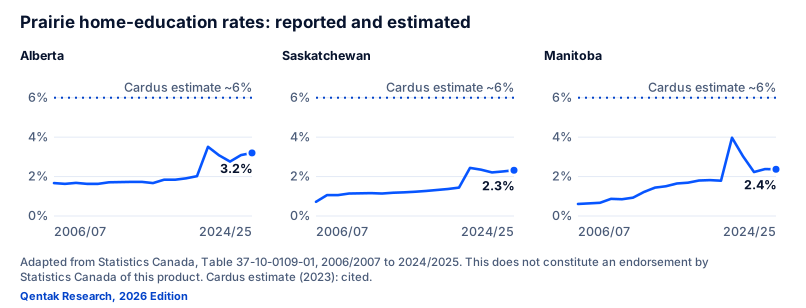
Prairie home-education rates: reported and estimated
Reported share of K-12 by year. The dotted line is Cardus's estimate of the true rate.
Estimate The dotted line at about 6% is an estimate by Cardus, not a count.
| School year | Alberta | Saskatchewan | Manitoba |
|---|---|---|---|
| 2006/07 | 1.67% | 0.72% | 0.61% |
| 2007/08 | 1.63% | 1.06% | 0.64% |
| 2008/09 | 1.68% | 1.06% | 0.67% |
| 2009/10 | 1.63% | 1.14% | 0.87% |
| 2010/11 | 1.63% | 1.15% | 0.85% |
| 2011/12 | 1.71% | 1.16% | 0.93% |
| 2012/13 | 1.72% | 1.14% | 1.22% |
| 2013/14 | 1.73% | 1.18% | 1.44% |
| 2014/15 | 1.73% | 1.20% | 1.51% |
| 2015/16 | 1.67% | 1.23% | 1.65% |
| 2016/17 | 1.84% | 1.27% | 1.69% |
| 2017/18 | 1.84% | 1.32% | 1.80% |
| 2018/19 | 1.91% | 1.37% | 1.82% |
| 2019/20 | 2.02% | 1.44% | 1.79% |
| 2020/21 | 3.51% | 2.44% | 3.97% |
| 2021/22 | 3.08% | 2.35% | 3.03% |
| 2022/23 | 2.76% | 2.21% | 2.23% |
| 2023/24 | 3.09% | 2.26% | 2.38% |
| 2024/25 | 3.20% | 2.32% | 2.37% |
Confidence (TRI-11): high (reported), low (estimated). 1.4-3.2% reported depending on year; about 6% estimated (Cardus)
Adapted from Statistics Canada, Table 37-10-0109-01, 2006/2007 to 2024/2025. This does not constitute an endorsement by Statistics Canada of this product. Cardus estimate (2023): cited.
Cite this chart
Adapted from Statistics Canada, Table 37-10-0109-01, 2006/2007 to 2024/2025. This does not constitute an endorsement by Statistics Canada of this product. Cardus estimate (2023): cited. Chart: "Prairie home-education rates: reported and estimated", Qentak Research, The State of Independent & Home Education in Canada, 2026 Edition. https://qentak.com/research/canada/alberta#chart-homeschool-prairie-rates
Embed as an image
<figure>
  <img src="https://qentak.com/research/charts/homeschool-prairie-rates.svg" alt="Three small line charts for Alberta, Saskatchewan and Manitoba of the reported home-education share from 2006/07 to 2024/25, each with a dotted marker at the Cardus estimate of about 6 percent." width="800" style="max-width:100%;height:auto">
  <figcaption>Adapted from Statistics Canada, Table 37-10-0109-01, 2006/2007 to 2024/2025. This does not constitute an endorsement by Statistics Canada of this product. Cardus estimate (2023): cited. Chart by <a href="https://qentak.com/research/canada/alberta#chart-homeschool-prairie-rates">Qentak Research</a>.</figcaption>
</figure>
Qentak's own text and charts are free to share with attribution. Statistics Canada data is used under the Open Licence; the full chapter on data, sources and terms is on the data page.
Why 4.9% and 6.7% are both right
Alberta Education's published totals for independent school authorities include students in supervised home-education programs run through those authorities. A Cardus memo of April 10, 2026 found 15,332 of the 48,024 students listed under independent authorities in 2024/25 were supervised home-education students (and 1,216 more were in shared-responsibility programs). Taking those out leaves about 31,500 regular independent students, close to Statistics Canada's series. Fraser's 6.7% (about 54,000 students in 2023/24) appears to use the broader count. Neither is an error; they answer different questions. The same memo argues the double counting inflates public reporting and recommends clearer tables.
Independent school funding
Accredited funded private schools receive about 70% of the public base instruction rates, and 100% for some categories such as early childhood services, according to several secondary sources; we have not read the Funding Manual 2025/26 itself. Alberta's per-student amounts are the lowest in the country among provinces, so the same percentage is a smaller number than elsewhere. A Cardus-linked column counts roughly 180 independent schools in Alberta (October 2025).
Home education
- Basis: Education Act section 20 and the Home Education Regulation (A.R. 89/2019).
- Notice: an annual Home Education Notification Form to the supervising school authority, which responds within 15 days.
- Two paths: supervised by a willing public, separate, francophone school board or accredited funded private school, which evaluates the program and is eligible for funding; or not supervised (notification only, no funding). 486 students were in the not-supervised stream in 2024/25.
- Funding: a Home Education Student Grant of $901 (Grades 1 to 12) or $450.50 (early childhood services) for 2025-26 in supervised programs.
- Numbers: registered home education nearly doubled in 2020/21 and has stayed high, at 3.1% to 3.2% of K-12. Cardus argues true prairie rates are nearer 6%.
School year
Compulsory attendance runs from age 6 to under 16 (as of September 1). The 2026-27 diploma examination windows are October 29 to November 6, January 14 to 28, April 6 to 14, June 11 to 28 and August 3 to 11.
Privacy context
The Office of the Information and Privacy Commissioner's PowerSchool report (F2025-IR-02, November 17, 2025) made 22 recommendations: 6 to educational bodies, 13 to PowerSchool, 3 to government. It found that public bodies remain accountable for their vendor's security. The investigation was under the Freedom of Information and Protection of Privacy Act; the Protection of Privacy Act replaced it for public bodies on June 11, 2025.
Sources: Statistics Canada, Table 37-10-0109-01; Fraser Institute 2026 Edition and 2025 spending edition; Cardus, memo Clarifying Public Reporting of the Alberta Education Student Population Statistics (April 10, 2026) and Charting New Horizons (2023); Alberta Education home education pages and funding form 2025-26; Alberta OIPC F2025-IR-02. Not legal advice.