QENTAK RESEARCH · 2026 EDITION
Nova Scotia: independent and home education, 2026 Edition
Nova Scotia has one of the largest independent sectors in Atlantic Canada, and no operating funding for it.
Snapshot
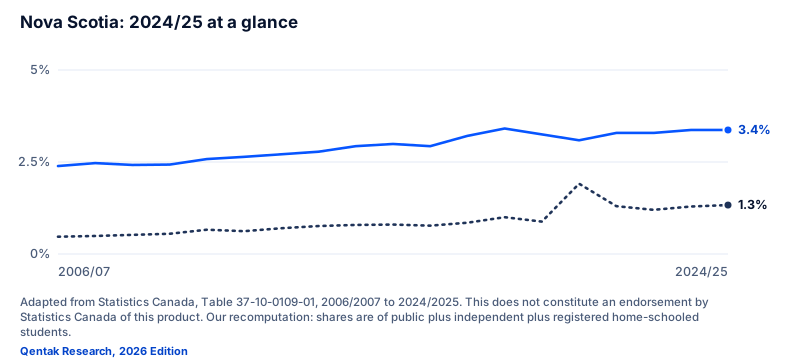
Nova Scotia: 2024/25 at a glance
4,719 independent students (3.4%); 1,860 registered home-educated (1.3%); no operating funding for independent schools.
| School year | Independent | Independent share | Home-educated | Home-education share |
|---|---|---|---|---|
| 2006/07 | 3,399 | 2.39% | 663 | 0.47% |
| 2007/08 | 3,441 | 2.47% | 684 | 0.49% |
| 2008/09 | 3,309 | 2.42% | 705 | 0.52% |
| 2009/10 | 3,264 | 2.43% | 732 | 0.55% |
| 2010/11 | 3,420 | 2.58% | 873 | 0.66% |
| 2011/12 | 3,426 | 2.64% | 807 | 0.62% |
| 2012/13 | 3,444 | 2.71% | 894 | 0.70% |
| 2013/14 | 3,489 | 2.78% | 948 | 0.76% |
| 2014/15 | 3,636 | 2.93% | 981 | 0.79% |
| 2015/16 | 3,669 | 2.99% | 978 | 0.80% |
| 2016/17 | 3,603 | 2.93% | 948 | 0.77% |
| 2017/18 | 3,975 | 3.21% | 1,053 | 0.85% |
| 2018/19 | 4,299 | 3.41% | 1,263 | 1.00% |
| 2019/20 | 4,179 | 3.25% | 1,134 | 0.88% |
| 2020/21 | 3,957 | 3.09% | 2,439 | 1.91% |
| 2021/22 | 4,311 | 3.29% | 1,707 | 1.30% |
| 2022/23 | 4,449 | 3.29% | 1,629 | 1.20% |
| 2023/24 | 4,638 | 3.37% | 1,773 | 1.29% |
| 2024/25 | 4,719 | 3.37% | 1,860 | 1.33% |
- Independent share
- Registered home-education share
- Independent change since 2006/07+39%
- Fraser share, 2023/243.5%
- Outside public, 2024/254.7%
Adapted from Statistics Canada, Table 37-10-0109-01, 2006/2007 to 2024/2025. This does not constitute an endorsement by Statistics Canada of this product. Our recomputation: shares are of public plus independent plus registered home-schooled students.
Cite this chart
Adapted from Statistics Canada, Table 37-10-0109-01, 2006/2007 to 2024/2025. This does not constitute an endorsement by Statistics Canada of this product. Our recomputation: shares are of public plus independent plus registered home-schooled students. Chart: "Nova Scotia: 2024/25 at a glance", Qentak Research, The State of Independent & Home Education in Canada, 2026 Edition. https://qentak.com/research/canada/nova-scotia#chart-province-nova-scotia-snapshot
Embed as an image
<figure>
  <img src="https://qentak.com/research/charts/province-nova-scotia-snapshot.svg" alt="Line chart of Nova Scotia's independent share (solid) and registered home-education share (dotted) of K-12 students, 2006/07 to 2024/25." width="800" style="max-width:100%;height:auto">
  <figcaption>Adapted from Statistics Canada, Table 37-10-0109-01, 2006/2007 to 2024/2025. This does not constitute an endorsement by Statistics Canada of this product. Our recomputation: shares are of public plus independent plus registered home-schooled students. Chart by <a href="https://qentak.com/research/canada/nova-scotia#chart-province-nova-scotia-snapshot">Qentak Research</a>.</figcaption>
</figure>
Qentak's own text and charts are free to share with attribution. Statistics Canada data is used under the Open Licence; the full chapter on data, sources and terms is on the data page.
At a glance
| Measure | Figure | Source and year |
|---|---|---|
| Independent students | 4,719 (3.4% of K-12) | Statistics Canada, 2024/25 |
| Independent share, Fraser measure | 3.5% in 2023/24, up from 1.6% in 2000/01 | Fraser Institute, 2026 Edition |
| Change in headcount since 2006/07 | +39% (3,399 to 4,719) | Statistics Canada |
| Registered home-educated | 1,860 (1.3%) in 2024/25; 1,134 in 2019/20 | Statistics Canada |
| Public spending per student | $16,800 (2022/23); up 10.8% in real terms since 2013/14 | Fraser Institute, 2025 Edition |
Independent schools and funding
Nova Scotia is one of five provinces that do not fund independent schools. Its independent share has more than doubled since 2000/01 (Fraser) and has held at about 3.3% to 3.4% in recent Statistics Canada data.
Home education
- Basis: Education Act (S.N.S. 2018, c. 1) section 83, and the regulations.
- Registration: an annual registration with the Department; the form is due by September 20 for a full school year, and the child must be age 5 by December 31. These details come from the Department's published pages as summarized to us; check the current form.
- Reporting: one progress report in June.
- Funding: none that we found.
- Numbers: registered home education more than doubled in 2020/21 (2,439) and has settled near 1,700 to 1,900 (1.3% of K-12).
2026/27 calendar
September 1, 2026 to June 30, 2027, with 195 teaching days. Spring break is March 8 to 12, 2027 (Department calendar, June 2026).
Sources: Statistics Canada, Table 37-10-0109-01; Fraser Institute 2026 Edition and 2025 spending edition; Nova Scotia Department of Education and Early Childhood Development school calendar 2026-27 and home-schooling pages. Not legal advice.