
QENTAK RESEARCH · 2026 EDITION
Ontario: independent and home education, 2026 Edition
Ontario has the most independent-school students in Canada, about 175,000, and no operating funding for any of them.
Snapshot
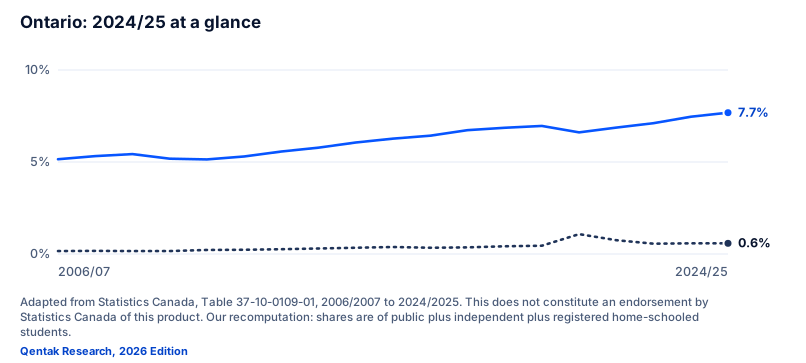
Ontario: 2024/25 at a glance
175,350 independent students (7.7%); 13,269 registered home-educated (0.6%); no operating funding for independent schools.
| School year | Independent | Independent share | Home-educated | Home-education share |
|---|---|---|---|---|
| 2006/07 | 114,375 | 5.15% | 3,582 | 0.16% |
| 2007/08 | 117,474 | 5.32% | 3,711 | 0.17% |
| 2008/09 | 119,145 | 5.43% | 3,501 | 0.16% |
| 2009/10 | 112,716 | 5.18% | 3,585 | 0.16% |
| 2010/11 | 111,486 | 5.14% | 4,746 | 0.22% |
| 2011/12 | 114,540 | 5.30% | 4,950 | 0.23% |
| 2012/13 | 120,252 | 5.57% | 5,682 | 0.26% |
| 2013/14 | 124,143 | 5.78% | 6,504 | 0.30% |
| 2014/15 | 129,609 | 6.06% | 7,311 | 0.34% |
| 2015/16 | 133,944 | 6.27% | 8,073 | 0.38% |
| 2016/17 | 138,414 | 6.43% | 7,365 | 0.34% |
| 2017/18 | 146,310 | 6.73% | 7,839 | 0.36% |
| 2018/19 | 151,077 | 6.86% | 9,192 | 0.42% |
| 2019/20 | 154,638 | 6.96% | 9,888 | 0.45% |
| 2020/21 | 145,080 | 6.61% | 23,670 | 1.08% |
| 2021/22 | 150,831 | 6.87% | 16,404 | 0.75% |
| 2022/23 | 158,148 | 7.11% | 12,366 | 0.56% |
| 2023/24 | 168,660 | 7.46% | 13,131 | 0.58% |
| 2024/25 | 175,350 | 7.68% | 13,269 | 0.58% |
- Independent share
- Registered home-education share
- Independent change since 2006/07+53%
- Fraser share, 2023/247.4%
- Outside public, 2024/258.3%
Adapted from Statistics Canada, Table 37-10-0109-01, 2006/2007 to 2024/2025. This does not constitute an endorsement by Statistics Canada of this product. Our recomputation: shares are of public plus independent plus registered home-schooled students.
Cite this chart
Adapted from Statistics Canada, Table 37-10-0109-01, 2006/2007 to 2024/2025. This does not constitute an endorsement by Statistics Canada of this product. Our recomputation: shares are of public plus independent plus registered home-schooled students. Chart: "Ontario: 2024/25 at a glance", Qentak Research, The State of Independent & Home Education in Canada, 2026 Edition. https://qentak.com/research/canada/ontario#chart-province-ontario-snapshot
Embed as an image
<figure>
  <img src="https://qentak.com/research/charts/province-ontario-snapshot.svg" alt="Line chart of Ontario's independent share (solid) and registered home-education share (dotted) of K-12 students, 2006/07 to 2024/25." width="800" style="max-width:100%;height:auto">
  <figcaption>Adapted from Statistics Canada, Table 37-10-0109-01, 2006/2007 to 2024/2025. This does not constitute an endorsement by Statistics Canada of this product. Our recomputation: shares are of public plus independent plus registered home-schooled students. Chart by <a href="https://qentak.com/research/canada/ontario#chart-province-ontario-snapshot">Qentak Research</a>.</figcaption>
</figure>
Qentak's own text and charts are free to share with attribution. Statistics Canada data is used under the Open Licence; the full chapter on data, sources and terms is on the data page.
At a glance
| Measure | Figure | Source and year |
|---|---|---|
| Independent students | 175,350 (7.7% of K-12) | Statistics Canada, 2024/25 |
| Independent share, Fraser measure | 7.4% in 2023/24, up from 4.9% in 2000/01 (a 51% rise in share) | Fraser Institute, 2026 Edition (Ontario release) |
| Change in headcount since 2006/07 | +53% (114,375 to 175,350) | Statistics Canada |
| Change since 2000/01 | About 57,900 more independent students and about 63,200 fewer public students | Fraser Institute, 2026 (Ontario release) |
| Registered home-educated | 13,269 (0.6%) in 2024/25; 9,888 in 2019/20 | Statistics Canada |
| Public spending per student | $16,164 (2022/23); down 1.7% in real terms since 2013/14 | Fraser Institute, 2025 Edition |
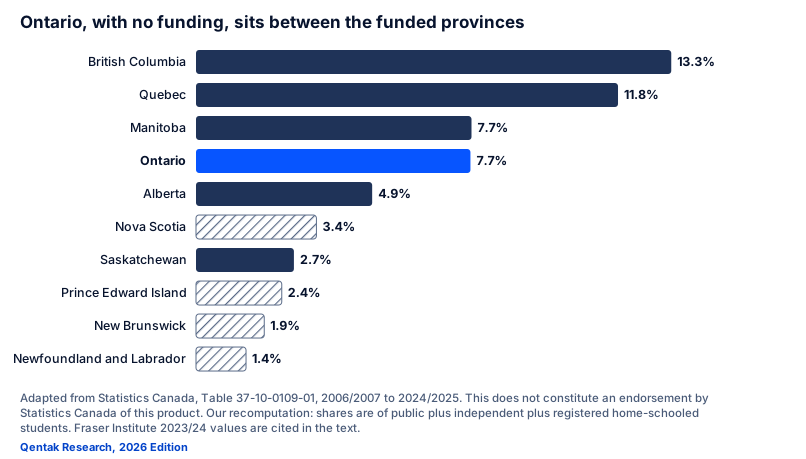
Ontario, with no funding, sits between the funded provinces
Independent share of K-12 students, 2024/25. Ontario is above Alberta and Saskatchewan, below British Columbia and Quebec, and level with Manitoba.
| Province | Independent share | Funds independent schools |
|---|---|---|
| British Columbia | 13.30% | Yes |
| Quebec | 11.81% | Yes |
| Manitoba | 7.71% | Yes |
| Ontario | 7.68% | No |
| Alberta | 4.93% | Yes |
| Nova Scotia | 3.37% | No |
| Saskatchewan | 2.74% | Yes |
| Prince Edward Island | 2.40% | No |
| New Brunswick | 1.91% | No |
| Newfoundland and Labrador | 1.40% | No |
- Ontario (no operating funding)
- Province that funds independent schools
- No operating funding
Adapted from Statistics Canada, Table 37-10-0109-01, 2006/2007 to 2024/2025. This does not constitute an endorsement by Statistics Canada of this product. Our recomputation: shares are of public plus independent plus registered home-schooled students. Fraser Institute 2023/24 values are cited in the text.
Cite this chart
Adapted from Statistics Canada, Table 37-10-0109-01, 2006/2007 to 2024/2025. This does not constitute an endorsement by Statistics Canada of this product. Our recomputation: shares are of public plus independent plus registered home-schooled students. Fraser Institute 2023/24 values are cited in the text. Chart: "Ontario, with no funding, sits between the funded provinces", Qentak Research, The State of Independent & Home Education in Canada, 2026 Edition. https://qentak.com/research/canada/ontario#chart-ontario-vs-funded
Embed as an image
<figure>
  <img src="https://qentak.com/research/charts/ontario-vs-funded.svg" alt="Ranked bars of independent share by province. Ontario is highlighted. Funded provinces are solid dark bars; unfunded provinces are hatched." width="800" style="max-width:100%;height:auto">
  <figcaption>Adapted from Statistics Canada, Table 37-10-0109-01, 2006/2007 to 2024/2025. This does not constitute an endorsement by Statistics Canada of this product. Our recomputation: shares are of public plus independent plus registered home-schooled students. Fraser Institute 2023/24 values are cited in the text. Chart by <a href="https://qentak.com/research/canada/ontario#chart-ontario-vs-funded">Qentak Research</a>.</figcaption>
</figure>
Qentak's own text and charts are free to share with attribution. Statistics Canada data is used under the Open Licence; the full chapter on data, sources and terms is on the data page.
Independent schools
Ontario's independent sector is large and varied. Cardus counted 1,445 independent schools in July 2022, up about 52% from 2013/14, and reports more than 1,670 in 2026, including 322 schools founded between January 2022 and December 2025. In its 2022 profile, 39% of Ontario's independent schools are religious and 41% are built around a special emphasis such as Montessori, arts or classical education. Its 2023 paper estimates Ontario has the largest number of independent and home-educated students combined, almost 166,000 in 2021, or almost 8% of K-12 enrolment.
Ontario's rate (7.4% to 7.7%) trails British Columbia and Quebec clearly, trails Manitoba on Fraser's measure (it is level with Manitoba on Statistics Canada's), and is above Alberta and Saskatchewan. Fraser describes Ontario as growing with no public funding.
Funding
None. Fraser's 2026 edition lists Ontario among the provinces that provide no per-student operating support to independent schools or financial support to families who choose them. A reform to "let money follow the child" is the policy argument we expect to intensify (see Section 6 of the report).
Home education
- Basis: the Education Act excuses a child from attending school if they are receiving satisfactory instruction at home (section 21(2)); Policy/Program Memorandum 131 (2002) sets out the ministry's direction.
- Notice: PPM 131 says parents should notify the school board in writing, annually, before September 1. It is direction, not a statutory duty, and boards are asked to treat the child as excused and not normally to investigate.
- Reporting: none provincially. There is no provincial testing, and an Ontario Secondary School Diploma is available only through a school.
- Funding: none that we found.
- Numbers: registered home education was 9,888 in 2019/20, jumped to 23,670 in 2020/21, and settled at about 13,100 to 13,300 in 2023/24 and 2024/25. Fraser's Ontario release reports 13,131 in 2023/24, more than triple 2007/08. Because notice is not compulsory, registered numbers are best read as a floor.
2026/27 calendar
The first day of school is Tuesday, September 8, 2026. The ministry makes 196 school days available in 2026/27; the minimum is 194. A typical board calendar has 187 instructional days and 7 professional activity days.
Privacy context
Twenty Ontario school boards and the Ministry of Education reported the 2025 PowerSchool breach to the Information and Privacy Commissioner. The IPC found the institutions lacked reasonable measures against unauthorized access and recommended action on contracts, vendor oversight, remote access and breach response. Boards were asked to show compliance within six months. Ontario's public-sector laws are FIPPA and MFIPPA.
Sources: Statistics Canada, Table 37-10-0109-01; Fraser Institute, Where Our Students Are Educated, 2026 Edition (Ontario release, September 2026) and Education Spending in Public Schools in Canada, 2025 Edition; Cardus, Naturally Diverse (2022), Charting New Horizons (2023) and School's Out for the Status Quo (2026); Ontario Policy/Program Memorandum 131; Ontario school-year calendar page. Not legal advice.