QENTAK RESEARCH · 2026 EDITION
Saskatchewan: independent and home education, 2026 Edition
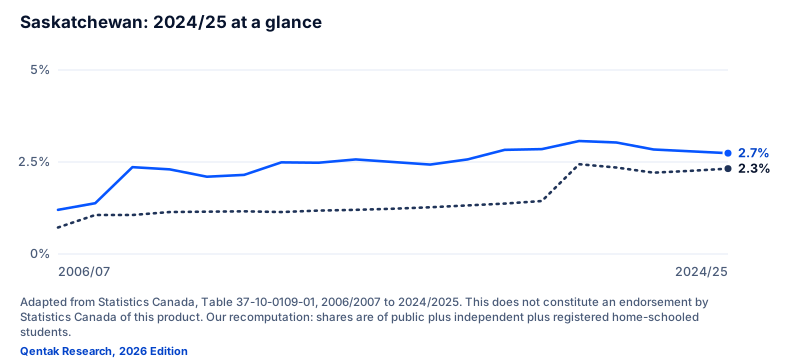
Saskatchewan's independent sector is small (2.7% of students) but has grown faster than any other province's since 2006/07, and its home-education rate is among the highest in the country.
Snapshot
Saskatchewan: 2024/25 at a glance
5,694 independent students (2.7%); 4,821 registered home-educated (2.3%); funds independent schools at 50% of a public amount.
| School year | Independent | Independent share | Home-educated | Home-education share |
|---|---|---|---|---|
| 2006/07 | 1,998 | 1.20% | 1,206 | 0.72% |
| 2007/08 | 2,316 | 1.38% | 1,782 | 1.06% |
| 2008/09 | 3,948 | 2.36% | 1,782 | 1.06% |
| 2009/10 | 3,867 | 2.30% | 1,914 | 1.14% |
| 2010/11 | 3,555 | 2.10% | 1,947 | 1.15% |
| 2011/12 | 3,690 | 2.15% | 1,992 | 1.16% |
| 2012/13 | 4,359 | 2.49% | 1,989 | 1.14% |
| 2013/14 | 4,386 | 2.48% | 2,097 | 1.18% |
| 2014/15 | 4,632 | 2.57% | 2,160 | 1.20% |
| 2015/16 | 4,554 | 2.50% | 2,241 | 1.23% |
| 2016/17 | 4,512 | 2.43% | 2,364 | 1.27% |
| 2017/18 | 4,854 | 2.57% | 2,484 | 1.32% |
| 2018/19 | 5,406 | 2.83% | 2,607 | 1.37% |
| 2019/20 | 5,511 | 2.85% | 2,781 | 1.44% |
| 2020/21 | 5,859 | 3.07% | 4,662 | 2.44% |
| 2021/22 | 5,844 | 3.03% | 4,539 | 2.35% |
| 2022/23 | 5,589 | 2.84% | 4,350 | 2.21% |
| 2023/24 | 5,646 | 2.79% | 4,587 | 2.26% |
| 2024/25 | 5,694 | 2.74% | 4,821 | 2.32% |
- Independent share
- Registered home-education share
- Independent change since 2006/07+185%
- Fraser share, 2023/242.8%
- Outside public, 2024/255.1%
Adapted from Statistics Canada, Table 37-10-0109-01, 2006/2007 to 2024/2025. This does not constitute an endorsement by Statistics Canada of this product. Our recomputation: shares are of public plus independent plus registered home-schooled students.
Cite this chart
Adapted from Statistics Canada, Table 37-10-0109-01, 2006/2007 to 2024/2025. This does not constitute an endorsement by Statistics Canada of this product. Our recomputation: shares are of public plus independent plus registered home-schooled students. Chart: "Saskatchewan: 2024/25 at a glance", Qentak Research, The State of Independent & Home Education in Canada, 2026 Edition. https://qentak.com/research/canada/saskatchewan#chart-province-saskatchewan-snapshot
Embed as an image
<figure>
  <img src="https://qentak.com/research/charts/province-saskatchewan-snapshot.svg" alt="Line chart of Saskatchewan's independent share (solid) and registered home-education share (dotted) of K-12 students, 2006/07 to 2024/25." width="800" style="max-width:100%;height:auto">
  <figcaption>Adapted from Statistics Canada, Table 37-10-0109-01, 2006/2007 to 2024/2025. This does not constitute an endorsement by Statistics Canada of this product. Our recomputation: shares are of public plus independent plus registered home-schooled students. Chart by <a href="https://qentak.com/research/canada/saskatchewan#chart-province-saskatchewan-snapshot">Qentak Research</a>.</figcaption>
</figure>
Qentak's own text and charts are free to share with attribution. Statistics Canada data is used under the Open Licence; the full chapter on data, sources and terms is on the data page.
At a glance
| Measure | Figure | Source and year |
|---|---|---|
| Independent students | 5,694 (2.7% of K-12) | Statistics Canada, 2024/25 |
| Independent share, Fraser measure | 2.8% in 2023/24 | Fraser Institute, 2026 Edition |
| Change in headcount since 2006/07 | +185% (1,998 to 5,694) | Statistics Canada |
| Registered home-educated | 4,821 (2.3%) in 2024/25; 2,781 in 2019/20 | Statistics Canada |
| Public spending per student | $15,774 (2022/23); down 14.8% in real terms since 2013/14 | Fraser Institute, 2025 Edition |
Independent schools and funding
Qualified Independent Schools receive 50% of the provincial per-student average, based on the actual number of eligible school-aged students registered. Funding began in 2012-13; about half of the previously unfunded independent schools qualified in the first year, and the number of qualified schools has been roughly stable since. A Cardus study found independent enrolment up 24.1% in the six years after funding began. Statistics Canada's series shows most of the province's growth was already under way earlier (from 1,998 students in 2006/07 to 3,690 in 2011/12) and a further 31% since 2012-13 (4,359 to 5,694). So funding has coincided with growth; we cannot say from this data that it caused it. A 2022 provincial announcement added funding and a new "certified independent school" category.
Home education
- Basis: Part VII of The Education Act, 1995 and the Home-based Education Program Regulations, 2015 (effective October 19, 2015); the ministry's policy manual covers procedures.
- Notice: parents give at least 30 days' notice before starting a program, with a written education plan, to a school division or conseil scolaire. Division deadlines and forms vary.
- Oversight: the school division monitors home-based learners. The policy manual has a section on a portfolio of student work. We could not confirm a parent "annual report" requirement.
- Funding: we found no single provincial rule. Division grants differ: Regina Public lists $800 per elementary student and $550 per high school student for materials (2026-27), and Saskatoon Public describes an annual reimbursement of up to $1,000 per child ($500 for Kindergarten).
- Numbers: registered home education was 1.4% of K-12 in 2019/20 and 2.3% to 2.4% since 2020/21. Cardus argues true prairie rates are nearer 6%.
School year
The Education Regulations, 2019 set 950 instructional hours for Grades 1 to 12 and 475 for Kindergarten (section 22). We did not retrieve a provincial 2026/27 calendar; divisions publish their own.
Sources: Statistics Canada, Table 37-10-0109-01; Fraser Institute 2026 Edition and 2025 spending edition; Government of Saskatchewan, Qualified Independent Schools page; Cardus, Qualified Independent Schools in Saskatchewan; school-division home-based education pages (Regina Public, Saskatoon Public, others). Not legal advice.