QENTAK RESEARCH · 2026 EDITION
Quebec: independent and home education, 2026 Edition
Quebec has the second-largest independent sector in Canada, about 139,000 students, funded at roughly 60% of the public amount for educational services.
Snapshot
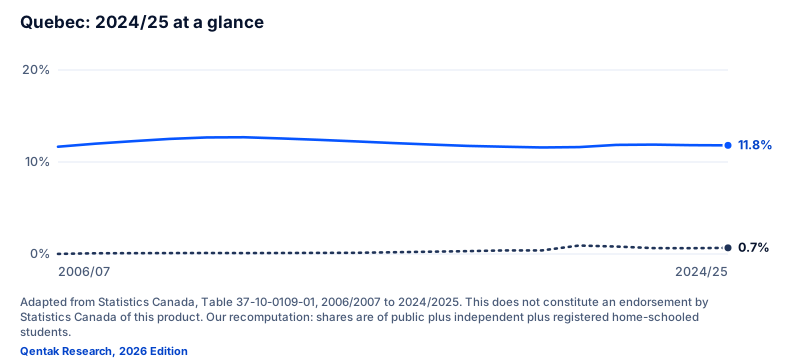
Quebec: 2024/25 at a glance
139,419 independent students (11.8%); 7,851 registered home-educated (0.7%); funds independent schools at ≈60% of a public amount.
| School year | Independent | Independent share | Home-educated | Home-education share |
|---|---|---|---|---|
| 2006/07 | 124,122 | 11.66% | 147 | 0.01% |
| 2007/08 | 125,262 | 11.99% | 789 | 0.08% |
| 2008/09 | 125,538 | 12.26% | 936 | 0.09% |
| 2009/10 | 125,910 | 12.51% | 1,014 | 0.10% |
| 2010/11 | 126,282 | 12.67% | 1,056 | 0.11% |
| 2011/12 | 125,838 | 12.69% | 1,038 | 0.10% |
| 2012/13 | 124,281 | 12.56% | 1,116 | 0.11% |
| 2013/14 | 123,384 | 12.41% | 1,182 | 0.12% |
| 2014/15 | 122,793 | 12.24% | 1,275 | 0.13% |
| 2015/16 | 122,439 | 12.06% | 1,929 | 0.19% |
| 2016/17 | 122,994 | 11.90% | 2,562 | 0.25% |
| 2017/18 | 123,684 | 11.75% | 3,303 | 0.31% |
| 2018/19 | 125,313 | 11.66% | 4,146 | 0.39% |
| 2019/20 | 126,870 | 11.58% | 4,308 | 0.39% |
| 2020/21 | 129,171 | 11.62% | 10,194 | 0.92% |
| 2021/22 | 133,488 | 11.86% | 9,165 | 0.81% |
| 2022/23 | 135,831 | 11.89% | 7,320 | 0.64% |
| 2023/24 | 137,688 | 11.83% | 7,350 | 0.63% |
| 2024/25 | 139,419 | 11.81% | 7,851 | 0.67% |
- Independent share
- Registered home-education share
- Independent change since 2006/07+12%
- Fraser share, 2023/2411.9%
- Outside public, 2024/2512.5%
Adapted from Statistics Canada, Table 37-10-0109-01, 2006/2007 to 2024/2025. This does not constitute an endorsement by Statistics Canada of this product. Our recomputation: shares are of public plus independent plus registered home-schooled students.
Cite this chart
Adapted from Statistics Canada, Table 37-10-0109-01, 2006/2007 to 2024/2025. This does not constitute an endorsement by Statistics Canada of this product. Our recomputation: shares are of public plus independent plus registered home-schooled students. Chart: "Quebec: 2024/25 at a glance", Qentak Research, The State of Independent & Home Education in Canada, 2026 Edition. https://qentak.com/research/canada/quebec#chart-province-quebec-snapshot
Embed as an image
<figure>
  <img src="https://qentak.com/research/charts/province-quebec-snapshot.svg" alt="Line chart of Quebec's independent share (solid) and registered home-education share (dotted) of K-12 students, 2006/07 to 2024/25." width="800" style="max-width:100%;height:auto">
  <figcaption>Adapted from Statistics Canada, Table 37-10-0109-01, 2006/2007 to 2024/2025. This does not constitute an endorsement by Statistics Canada of this product. Our recomputation: shares are of public plus independent plus registered home-schooled students. Chart by <a href="https://qentak.com/research/canada/quebec#chart-province-quebec-snapshot">Qentak Research</a>.</figcaption>
</figure>
Qentak's own text and charts are free to share with attribution. Statistics Canada data is used under the Open Licence; the full chapter on data, sources and terms is on the data page.
At a glance
| Measure | Figure | Source and year |
|---|---|---|
| Independent students | 139,419 (11.8% of K-12) | Statistics Canada, 2024/25 |
| Independent share, other measures | 11.9% (Fraser, 2023/24); 10.5% (Cardus, 2026, a different basis) | Fraser Institute; Cardus |
| Change in headcount since 2006/07 | +12% (124,122 to 139,419) | Statistics Canada |
| Registered home-educated | 7,851 (0.7%) in 2024/25; 4,308 in 2019/20; 10,194 in 2020/21 | Statistics Canada |
| Public spending per student | $19,484 (2022/23), the highest in Canada; up 40.6% in real terms since 2013/14 | Fraser Institute, 2025 Edition |
Independent schools
Quebec's independent share has hovered around 11% to 12% for two decades, so its growth since 2006/07 (+12%) is modest next to Ontario's or British Columbia's. It starts from a high base. The earlier Statistics Canada release counted 134,331 independent students in 2019/20 because it included adult and vocational programs; the current "regular programs for youth" series gives 126,870 for the same year. Fraser's 2022 edition (ministry-based) reported 126,868, which matches the narrower series.
Funding
Quebec partially funds approved private schools. The most-cited figure is about 60% of the public per-pupil amount, for educational services only (not buildings or student services). Sources differ: one comparison cites about 50%, and the federation of private schools (FEEP) says the subsidy amounts to about 40% of the true cost of educating a student. We have not read the ministry's current budget rules, so treat 60% as approximate. About two-thirds of private schools are approved for funding, according to published commentary.
Home education
Quebec's regime is more structured than most provinces and is not an "authorization" system. Under the Regulation respecting homeschooling:
- Annual notice to the minister (and the school service centre) by July 1, or within 10 days of the child leaving school.
- A learning project, implemented by September 30 (or later if the child leaves school mid-year); the minister may ask for a revised project.
- A written status report on implementation, and two progress reports on the child's learning each year, with the school year running July 1 to June 30.
- Secondary summaries add ministerial examinations; we have not confirmed that from an official text.
Quebec's registered home education has grown sharply from a handful of children in 2006/07 (147) to 7,851 in 2024/25. We found no provincial home-education funding.
School year
A secondary summary cites 180 days of up to 200 and 720 hours of instruction. We have not read the Basic School Regulation directly (the legislation site refused automated access), so we do not state a 2026/27 calendar for Quebec.
Privacy context
Quebec's private-sector and public-sector privacy rules were overhauled by Law 25. Bill 96 is a language law and is a separate compliance matter for schools that operate in English.
Sources: Statistics Canada, Table 37-10-0109-01; Fraser Institute 2026 Edition and 2025 spending edition; Cardus, Better Together (2026); FEEP; Policy Alternatives commentary; quebec.ca homeschooling pages (accessed 15 November 2026); Western Quebec School Board homeschooling requirements 2024-25. Not legal advice.