QENTAK RESEARCH · IN DEPTH · 2026 EDITION
Manitoba: independent and home education, 2026 Edition
Manitoba is the deepest page in this edition because it is the only province where we could read the ministry's own October 2025 enrolment report and 2025/26 funding guide.
Snapshot
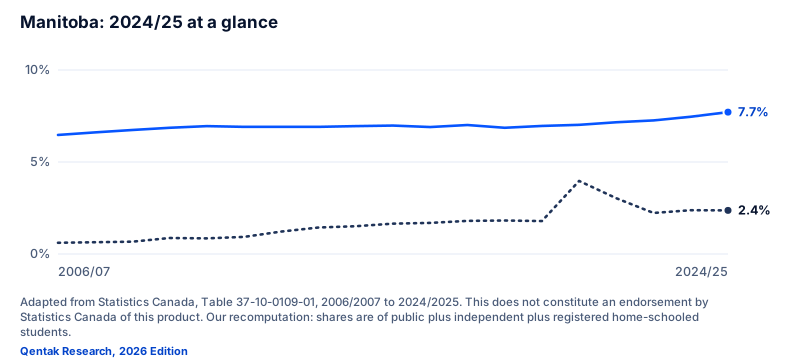
Manitoba: 2024/25 at a glance
16,920 independent students (7.7%); 5,199 registered home-educated (2.4%); funds independent schools at 50% of a public amount.
| School year | Independent | Independent share | Home-educated | Home-education share |
|---|---|---|---|---|
| 2006/07 | 12,543 | 6.47% | 1,176 | 0.61% |
| 2007/08 | 12,780 | 6.61% | 1,236 | 0.64% |
| 2008/09 | 12,951 | 6.74% | 1,290 | 0.67% |
| 2009/10 | 13,203 | 6.86% | 1,677 | 0.87% |
| 2010/11 | 13,398 | 6.95% | 1,635 | 0.85% |
| 2011/12 | 13,416 | 6.91% | 1,812 | 0.93% |
| 2012/13 | 13,491 | 6.91% | 2,385 | 1.22% |
| 2013/14 | 13,512 | 6.91% | 2,811 | 1.44% |
| 2014/15 | 13,641 | 6.95% | 2,964 | 1.51% |
| 2015/16 | 13,833 | 6.98% | 3,276 | 1.65% |
| 2016/17 | 13,815 | 6.90% | 3,393 | 1.69% |
| 2017/18 | 14,196 | 7.01% | 3,639 | 1.80% |
| 2018/19 | 14,019 | 6.86% | 3,708 | 1.82% |
| 2019/20 | 14,325 | 6.96% | 3,690 | 1.79% |
| 2020/21 | 14,184 | 7.02% | 8,028 | 3.97% |
| 2021/22 | 14,556 | 7.16% | 6,150 | 3.03% |
| 2022/23 | 15,099 | 7.26% | 4,629 | 2.23% |
| 2023/24 | 16,011 | 7.46% | 5,106 | 2.38% |
| 2024/25 | 16,920 | 7.71% | 5,199 | 2.37% |
- Independent share
- Registered home-education share
- Independent change since 2006/07+35%
- Fraser share, 2023/248.7%
- Outside public, 2024/2510.1%
Adapted from Statistics Canada, Table 37-10-0109-01, 2006/2007 to 2024/2025. This does not constitute an endorsement by Statistics Canada of this product. Our recomputation: shares are of public plus independent plus registered home-schooled students.
Cite this chart
Adapted from Statistics Canada, Table 37-10-0109-01, 2006/2007 to 2024/2025. This does not constitute an endorsement by Statistics Canada of this product. Our recomputation: shares are of public plus independent plus registered home-schooled students. Chart: "Manitoba: 2024/25 at a glance", Qentak Research, The State of Independent & Home Education in Canada, 2026 Edition. https://qentak.com/research/canada/manitoba#chart-province-manitoba-snapshot
Embed as an image
<figure>
  <img src="https://qentak.com/research/charts/province-manitoba-snapshot.svg" alt="Line chart of Manitoba's independent share (solid) and registered home-education share (dotted) of K-12 students, 2006/07 to 2024/25." width="800" style="max-width:100%;height:auto">
  <figcaption>Adapted from Statistics Canada, Table 37-10-0109-01, 2006/2007 to 2024/2025. This does not constitute an endorsement by Statistics Canada of this product. Our recomputation: shares are of public plus independent plus registered home-schooled students. Chart by <a href="https://qentak.com/research/canada/manitoba#chart-province-manitoba-snapshot">Qentak Research</a>.</figcaption>
</figure>
Qentak's own text and charts are free to share with attribution. Statistics Canada data is used under the Open Licence; the full chapter on data, sources and terms is on the data page.
At a glance (Manitoba Education and Early Childhood Learning, enrolment on October 1, 2025)
- Total enrolment: 224,724 (includes 1,826 nursery pupils).
- Public: 198,589, including 3,407 students in division-administered First Nations schools (down 564, or 0.3%).
- Funded independent schools: 71 schools, 18,012 students (up 3.8%).
- Non-funded independent schools: 67 schools, 2,592 students (down 2.3%).
- All independent: 138 schools, 20,604 students, 9.2% of enrolment (our division of the ministry's numbers; up 3.0%).
- Home-educated: 5,531 students, 2.5% of enrolment (up 6.4%).
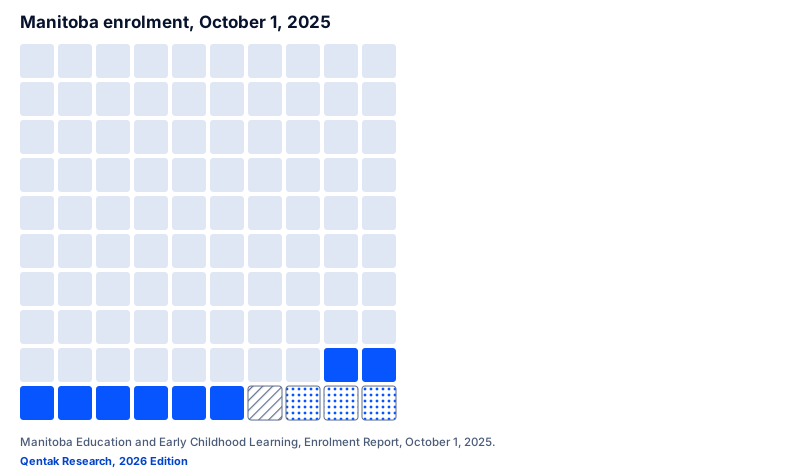
Manitoba enrolment, October 1, 2025
Each square is about 1% of 224,724 students (nursery students counted in the total).
| Group | Students | Schools |
|---|---|---|
| Public (incl. division-administered First Nations schools) | 198,589 | |
| Funded independent | 18,012 | 71 |
| Non-funded independent | 2,592 | 67 |
| Home-educated | 5,531 | |
| Total (includes 1,826 nursery pupils) | 224,724 |
- 198,589 Public (incl. First Nations schools run by divisions) (88%)
- 18,012 Funded independent (8%, 71 schools)
- 2,592 Non-funded independent (1%, 67 schools)
- 5,531 Home-educated (3%)
Manitoba Education and Early Childhood Learning, Enrolment Report, October 1, 2025.
Cite this chart
Manitoba Education and Early Childhood Learning, Enrolment Report, October 1, 2025. Chart: "Manitoba enrolment, October 1, 2025", Qentak Research, The State of Independent & Home Education in Canada, 2026 Edition. https://qentak.com/research/canada/manitoba#chart-manitoba-enrolment-2025
Embed as an image
<figure>
  <img src="https://qentak.com/research/charts/manitoba-enrolment-2025.svg" alt="A 10 by 10 grid: public 198,589, funded independent 18,012, non-funded independent 2,592 and home-educated 5,531 students." width="800" style="max-width:100%;height:auto">
  <figcaption>Manitoba Education and Early Childhood Learning, Enrolment Report, October 1, 2025. Chart by <a href="https://qentak.com/research/canada/manitoba#chart-manitoba-enrolment-2025">Qentak Research</a>.</figcaption>
</figure>
Qentak's own text and charts are free to share with attribution. Statistics Canada data is used under the Open Licence; the full chapter on data, sources and terms is on the data page.
Taken together, independent and home-educated students are about 11.6% of Manitoba students (our arithmetic: 26,135 of 224,724).
Three schools moved from non-funded to funded in 2025, five new non-funded schools opened and one school closed.
How other sources count Manitoba
Different publishers produce different Manitoba numbers because they count different things, not because any is careless.
| Source and year | Independent | Home-educated | Note |
|---|---|---|---|
| Manitoba ministry, Oct 1 2025 | 20,604 | 5,531 | Primary source; funded plus non-funded |
| Statistics Canada, 2024/25 | 16,920 | 5,199 | Survey count; counts Catholic schools as independent |
| Statistics Canada, 2023/24 | 16,011 | 5,106 | Same series |
| Fraser Institute, 2023/24 | 8.7% share | not reported in our sources | Ministry-based; share, not headcount |
| Statistics Canada, 2019/20 | 14,325 | 3,690 | Earlier year |
Home education more than doubled in Manitoba in 2020/21 (3,690 to 8,028 in the current Statistics Canada series), eased to 5,106 by 2023/24, and has risen again to 5,531 in the ministry's 2025 count. Fraser's 2026 edition puts Manitoba's independent share at 8.7% (2023/24), third in the country behind British Columbia and Quebec. Manitoba's own 2025 figures give 9.2%.
Independent school funding (2025/26)
Manitoba funds independent schools that meet The Public Schools Act, its regulations and departmental policies. The ministry classifies them as funded or non-funded; the same classification Fraser and Cardus describe when they list Manitoba among the provinces that partially fund independent schools.
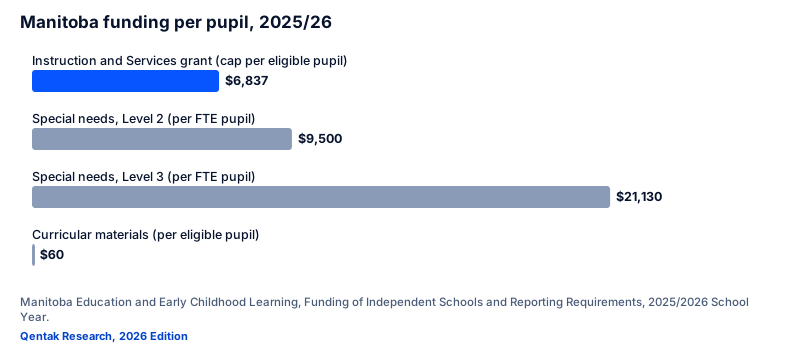
- Instruction and Services grant: the lesser of (a) $6,837 per eligible pupil (counted on the first Wednesday of October), or (b) the school's eligible operating expenditures after specified deductions. The rate comes from a formula that takes 50% of the public net operating cost per full-time-equivalent pupil (2023/24 base) for each public school division.
- Special needs: Level 2, $9,500 per FTE pupil; Level 3, $21,130 per FTE pupil.
- Curricular materials: $60 per eligible pupil.
- Indirect support: shared service agreements for clinician services, facilities and transportation.
- Eligible pupils exclude nursery pupils, pupils taking more courses at another school, pupils whose education is paid by a band or the federal government, and pupils whose cost is paid by an organization or division.
- Reporting: enrolment is submitted to the Education Funding Branch by the October deadline (October 15 in 2025). Public, funded and non-funded independent schools all report enrolment annually.
So Manitoba's "50%" is a share of public net operating cost per FTE pupil, capped at a dollar amount, with separate grants added. It is not a flat 50% of everything a public student receives. Public spending per student in Manitoba was $17,036 in 2022/23 (Fraser Institute, 2025 Edition), down 3.0% in real terms since 2013/14.
Manitoba funding per pupil, 2025/26
The 50% formula is a share of public net operating cost per FTE pupil, capped at a dollar amount. Special-needs and materials grants are added.
| Grant | Amount (CAD) |
|---|---|
| Instruction and Services grant (cap per eligible pupil) | $6,837 |
| Special needs, Level 2 (per FTE pupil) | $9,500 |
| Special needs, Level 3 (per FTE pupil) | $21,130 |
| Curricular materials (per eligible pupil) | $60 |
Manitoba Education and Early Childhood Learning, Funding of Independent Schools and Reporting Requirements, 2025/2026 School Year.
Cite this chart
Manitoba Education and Early Childhood Learning, Funding of Independent Schools and Reporting Requirements, 2025/2026 School Year. Chart: "Manitoba funding per pupil, 2025/26", Qentak Research, The State of Independent & Home Education in Canada, 2026 Edition. https://qentak.com/research/canada/manitoba#chart-manitoba-grants
Embed as an image
<figure>
  <img src="https://qentak.com/research/charts/manitoba-grants.svg" alt="Bars of Manitoba grant amounts for funded independent schools: Instruction and Services capped at $6,837, special needs level 2 $9,500, level 3 $21,130, curricular materials $60." width="800" style="max-width:100%;height:auto">
  <figcaption>Manitoba Education and Early Childhood Learning, Funding of Independent Schools and Reporting Requirements, 2025/2026 School Year. Chart by <a href="https://qentak.com/research/canada/manitoba#chart-manitoba-grants">Qentak Research</a>.</figcaption>
</figure>
Qentak's own text and charts are free to share with attribution. Statistics Canada data is used under the Open Licence; the full chapter on data, sources and terms is on the data page.
Home education in Manitoba
Manitoba has no homeschooling regulation. The duties sit in The Public Schools Act (sections 1.1, 260.1 and 262) and in the Homeschooling Office's current procedures.
- Compulsory age: 6, or 5 and turning 6 by December 31, to under 18 (section 1.1).
- Notification: a Student Notification Form each year, per child. Returning families submit by September 1 (the form opens July 1). New homeschoolers notify within 30 days of establishing the home school. A child may be notified from September of the year they turn 5, and must be by September of the year they turn 6. Notification ends on enrolment in a public or independent school, at age 18, or on earning the Manitoba High School Diploma.
- Progress reports: a January Progress Report, currently due January 31 (form available from January 1) and a June Progress Report, currently due June 30 (available from June 1), for each student. The statute leaves the schedule and content to the Minister (section 260.1(4)), so these dates are the Homeschooling Office's current schedule and could change.
- Support and oversight: Homeschooling Liaisons may contact parents about the program outline or progress. The office issues a Confirmation of Notification letter. Where parents are separated, everyone with decision authority must agree and sign.
- Funding: none. The ministry states that provincial funding is not available to families who homeschool.
- Tests and credits: no provincial tests are required, and the Homeschooling Office issues no high school credits or transcripts. A family that wants a Manitoba diploma pathway has to enrol the student in a school for it.
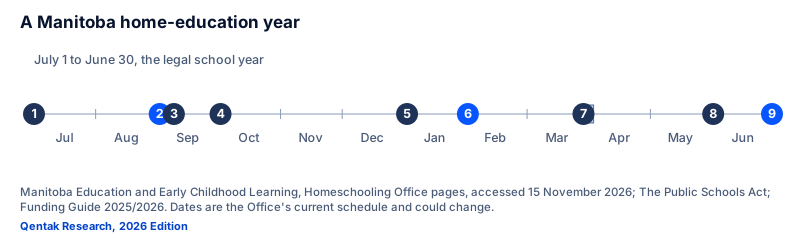
A Manitoba home-education year
Notification, progress reports and the October count, on the July to June legal school year.
| Date | What happens |
|---|---|
| Jul 1 | The Student Notification Form opens online for returning families. |
| Sep 1 | Returning families notify (new homeschoolers notify within 30 days of starting). |
| Sep 8 | First day of the 2026/27 school year. |
| Oct | Enrolment count date for funded schools; submission follows by the October deadline (October 15 in 2025). |
| Jan 1 | The January Progress Report form becomes available. |
| Jan 31 | January Progress Report due, for each child (current schedule). |
| Mar 29 | Spring break, March 29 to April 2, 2027. |
| Jun 1 | The June Progress Report form becomes available. |
| Jun 30 | June Progress Report due and last day of the school year. |
- Jul 1 The Student Notification Form opens online for returning families.
- Sep 1 Returning families notify (new homeschoolers notify within 30 days of starting).
- Sep 8 First day of the 2026/27 school year.
- Oct Enrolment count date for funded schools; submission follows by the October deadline (October 15 in 2025).
- Jan 1 The January Progress Report form becomes available.
- Jan 31 January Progress Report due, for each child (current schedule).
- Mar 29 Spring break, March 29 to April 2, 2027.
- Jun 1 The June Progress Report form becomes available.
- Jun 30 June Progress Report due and last day of the school year.
Manitoba Education and Early Childhood Learning, Homeschooling Office pages, accessed 15 November 2026; The Public Schools Act; Funding Guide 2025/2026. Dates are the Office's current schedule and could change.
Cite this chart
Manitoba Education and Early Childhood Learning, Homeschooling Office pages, accessed 15 November 2026; The Public Schools Act; Funding Guide 2025/2026. Dates are the Office's current schedule and could change. Chart: "A Manitoba home-education year", Qentak Research, The State of Independent & Home Education in Canada, 2026 Edition. https://qentak.com/research/canada/manitoba#chart-manitoba-calendar
Embed as an image
<figure>
  <img src="https://qentak.com/research/charts/manitoba-calendar.svg" alt="A timeline from July 1 to June 30 with nine numbered dates: notification form opens, returning families notify by September 1, first day of school September 8, October enrolment count, January report form and due date January 31, spring break, June form and the June 30 due date." width="800" style="max-width:100%;height:auto">
  <figcaption>Manitoba Education and Early Childhood Learning, Homeschooling Office pages, accessed 15 November 2026; The Public Schools Act; Funding Guide 2025/2026. Dates are the Office's current schedule and could change. Chart by <a href="https://qentak.com/research/canada/manitoba#chart-manitoba-calendar">Qentak Research</a>.</figcaption>
</figure>
Qentak's own text and charts are free to share with attribution. Statistics Canada data is used under the Open Licence; the full chapter on data, sources and terms is on the data page.
2026/27 school calendar
- First day: Tuesday, September 8, 2026. Last day: Wednesday, June 30, 2027. The legal school year runs July 1 to June 30.
- Minimum school days: 191 (School Days, Hours and Vacations Regulation 101/95, section 3). The minimum is 196 for 2025/26 and 193 for 2027/28.
- Instructional day: at least 5.5 hours including recesses, all grades. Non-instructional days: at most 10, at least 5 of them for professional development.
- Spring break: March 29 to April 2, 2027.
- Holidays: Truth and Reconciliation Day (September 30), Thanksgiving (October 12), Remembrance Day (November 11), Louis Riel Day (February 15, 2027), Good Friday (March 26, 2027) and Victoria Day (May 24, 2027).
Divisions and independent schools publish their own calendars within these rules.
What it means
Manitoba is the clearest example in this report of a province where independent education and home education both sit at high shares (roughly one in eleven students is in an independent school, and one in forty in home education) under legal frameworks that are legible to the authority. It funds independent schools at a defined share of public cost and leaves home educators to notify and report without funding. For schools and co-ops, the practical needs are a clean way to evidence a January and a June report per child and, for funded schools, accurate enrolment on the October count date.
Sources: Manitoba Education and Early Childhood Learning, Enrolment Report, October 1, 2025 (April 2026); Funding of Independent Schools and Reporting Requirements 2025/2026 (September 2025); Homeschooling Office pages, accessed 15 November 2026; The Public Schools Act (C.C.S.M. c. P250); School Days, Hours and Vacations Regulation 101/95; Statistics Canada, Table 37-10-0109-01; Fraser Institute (2025 spending edition; 2026 enrolment edition). Corrections: /research/corrections. This page describes published rules and is not legal advice.